
expedition hacks/secret tips
This is a list of everything I can think of that go under the radar but helps massively while on expeditions.
- Learn how to set up your tent extremely fast -under 2 mins is a good time to aim for, whether it is pouring rain or the sandflies or midgies are in the thousands you want to be able to get that tent up asap. If you go on an expedition and it’s your first time opening your brand-new tent, you are going to struggle getting that tent up fast especially in wet conditions.
- Same as before but with a tarp – learn how to pack it down properly to allow yourself the optimal chance to set it up the next time as quick and efficiently as possible. Nothing worse than undoing a tarp to find all of the ropes tangled with each other.
- Holy socks – These are only to be warn in the tent, never anywhere else. An expedition feels so much more comfortable with a nice dry pair of socks to sleep in.
- Insulate your power banks/batteries with the holy socks, kills 2 birds with one stone – makes sure your socks don’t get dirty or wet and keeps your battery packs insulated so they don’t lose charge.
- Bring 3-4 x what you think you need for a repair kit, especially for long trips. cable ties, tape, steel cable, mini d shackles etc. This saved us on our Patagonia trip with Mat’s sleeping mat- we went through all of his spare patched, all of mine and had several more patches in our repair kits. We still had to end up chopping some of the tarp up to patch some holes. In saying that 20 odd holes in a sleeping mat is probably a record.
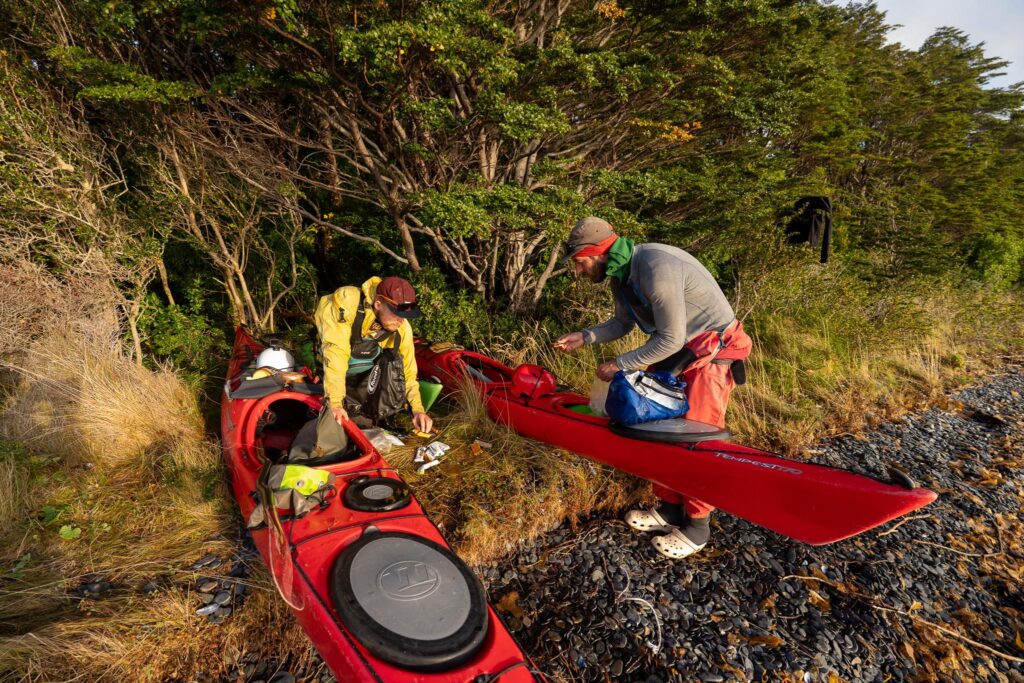
- Pre-pack your kayak before you go – make sure everything you are planning on bringing with you will actually fit in. Your packing system will be worse than this pre-pack once you are on the expedition as things will be wet, it might be raining and you might just be shoving stuff in however you can etc. So always make sure you have a tiny bit of spare space somewhere.
- Timing the gusts on windy days – Don’t try to make ground during the wind gusts, just control it so you don’t go backwards then try to make ground between them. Trying to force through the gusts will make you extremely tired during a big windy day.
- Eat before you are hungry and drink before you are thirsty – Everybody has probably heard the saying if you are thirsty that means you are already de-hydrated. On expeditions these are super important, you need to be constantly snacking and eating well to keep your energy up. Water intake and electrolytes are the same – just keep sipping during the day otherwise you will crash fast if you get de-hydrated. This does change if water is low and you are not in an area with more water, then you must ration appropriately.
- For big, long days on the water just try and keep the momentum going in your kayak. On big expeditions, kayaks can be 70+ kg (150+ pounds). The hardest part is getting them up to speed, once up to speed it’s not very hard to keep a consistent pace. So instead of doing short bursts of paddling then stopping, try to keep the kayak moving at all times.
- Have a strategy for rough weather days – where to go if things go wrong, when to call it, group structure etc. Super important especially if you are tired and beaten up, it’s much easier if you remember the plan that you rehearsed earlier that day than to try and make one up on the spot.
- Try your best to memorize where everything is in your kayak – Makes everything much easier if you are looking for something especially group gear – If someone else is looking for the cooker that is in your kayak and don’t know where exactly it is, they might need to empty out your entire kayak to find it. Or you could say middle hatch, towards the front, green drybag.
- Think of the next morning – This is for the big days where you get to camp and just want to eat and go to bed. Think about yourself and the group the next morning. A 2 min task like hanging a drysuit up to air out/dry is much better than having to put a soaking wet drysuit on the next morning. Or setting up the tarp once you arrive at camp if there’s potential rain the next morning, much better to do it the night before rather than setting it up first thing.
Brody is an expedition athlete and adventure content creator based in Wānaka, New Zealand. With six years guiding in Fiordland and multi‑week missions across Patagonia, Stewart Island, and soon Antarctica, he specializes in cold‑water, remote‑environment expeditions. Through Remote Horizons, he shares real‑world gear insights, expedition planning advice, and storytelling from some of the wildest coastlines on the planet.