
Discover the lessons, skills, and survival insights I gained from 6 years guiding in Fiordland — one of New Zealand’s wildest and most challenging places.
Intro
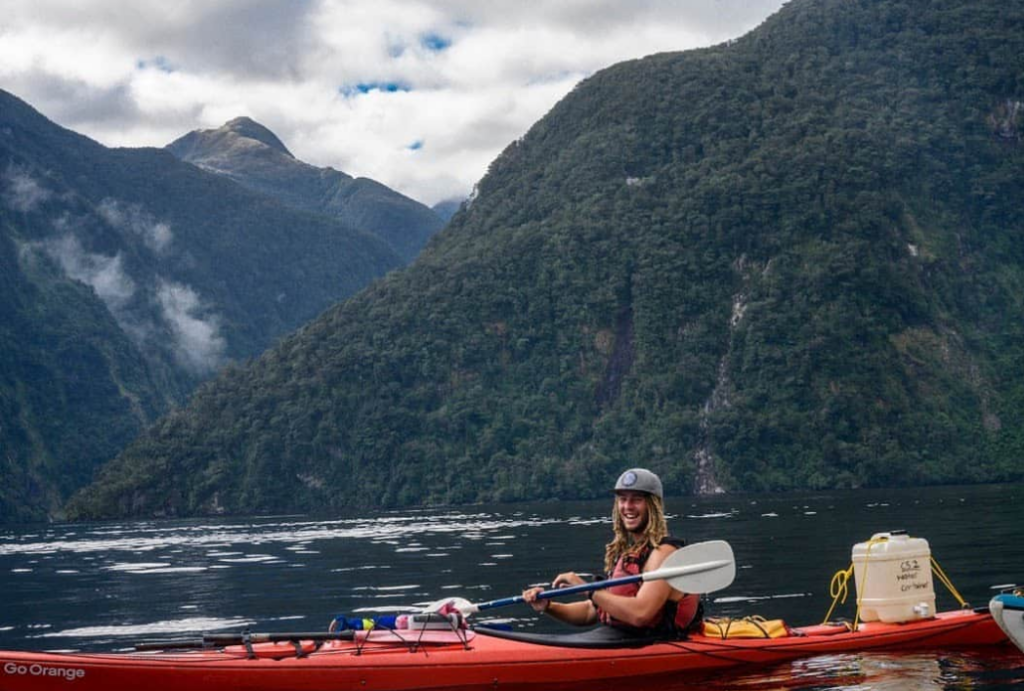
Fiordland national park is known for the famous landmarks such as Milford Sound, The Kepler Track, The Routeburn Track and The Milford Track to name a few. The park itself is 12,607 km² in area hosting 14 fiords total, 4 ‘great walks’ and an estimated 3800 lakes. This is the area I spent 6 years of my life. 4 years as a kayak guide in both Milford and Doubtful Sound, 1 year on the overnight cruise boats as a crew and 1 year on the overnight boats as the nature guide.
How I became a guide in Fiordland
I was lucky enough to study outdoor education in Timaru for 2 years, during the second year they do a work placement with different companies throughout the South Island. I chose to head down to Fiordland to do sea kayak guiding for 1 week with a company called ‘Go Orange’. Mainly at the time because I was heavy into my whitewater kayaking and I knew that area had some of the best whitewater kayaking in New Zealand.
However, I quickly loved the idea of sea kayaking as a means of travel and of course Milford sound hooked me in. It was an amazing week, and I was set on applying for a job as soon as I finished studying. I went to Fiordland on a couple more private kayaking trips and this cemented my love for the area even more. With the extra trips I got to see it in all kinds of weather, rain, sunshine and snow. There really isn’t a bad day there.
Guide training
Guide training is a brutal start to the guiding career in Fiordland; you need to prove you have the rescue skills to be able to lead groups by yourself and make sure you can do it alone. This means drills such as ‘all ins’ which is basically a scenario where your entire group all gets flipped upside down at the same time (worst case). The guiding ratios in Nz are 8:1 so you have to get 8 people back in there kayaks as fast as possible. For reference a good rescue is about 2 mins for a double kayak. You need to be able to confidently roll, and self-rescue yourself, also perform 2 different ways of getting into your kayak from in the water. This and learning enough about the area to look confident enough talking about it to clients. All within 2-3 weeks.
First season
In my first season I was really lucky to have some good senior guides to learn off. This made the learning process much faster and therefore allowed to get out guiding by myself within 2 weeks. As a first-year guide we would normally stick to the easier and shorter trips like the 2 & 5 tours in Milford Sound and the 3-hour tours in Doubtful sound. These tours both start with 2 hours of travelling before even getting to the kayaks. A 6am departure everyday ensures we meet our clients at the kayaks at 8am. Complete our day tour then drive back for a home arrival of about 5:30pm. Long days but in the early seasons even just being out there was amazing. Of course, days off we were free to explore the absolute playground that Fiordland is for outdoor adventurers. Whether that be more kayaking, walking one of the 4 world class hiking trails or even just hanging out at the pristine lake Te Anau.
Second season
This is where the fun really begins, the company has figured out that you have what it takes and if they think you are ready you get to start training up for the overnight trips in Doubtful sound. These were by far my favorite trip. We had a campground in an area called Hall arm. This was used by our company to host overnight trips. This trip was an upgrade from the day trips as you get better kayaks, generally better clients, more tips, and best of all you only had to wash all the gear once in 2 days not twice for 2 days of work. I instantly fell in love with these trips and tried my best to guide them as much as possible between my day trips.
Third season
This was the season everything really clicked, I was comfortable running overnight trips, I was training new guides and made many friends in Milford and Te Anau. I knew all of the secret spots and missions that the tourists don’t know, and the whitewater kayaking was insane this year. On average i would have been whitewater kayaking 3x a week. Nothing crazy really happened throughout the season, but it was just a really good season.
Fourth season
This one was hectic. I had originally started this summer season planning on working full time in Australia as an outdoor guide, but in September 2019 the area I was based out of was destroyed by massive bush fires. Which meant the company I was working for couldn’t operate. I rang my old boss from Fiordland and asked for my job back and to my delight she said yes, one of the trainees couldn’t hack it so I was immediately booking flights home. It was also the summer of wind and storms. Majority of the trips had significant wind. To explain the weather in the area a bit more. Fiordland lies directly in line with the ‘Roaring 40s’ you can drive past the exact place latitude 45 south crosses the Milford highway. This is notorious for bringing storms and wind. For us guiding in Fiordland we don’t have a wind cutoff, it’s up to us to decide if we cancel the trip. Places like Abel Tasman up the far end of the south, most companies have a 20knot cutoff where they won’t run trips. That is a light wind day for us. We were guiding a lot of days in 30+knots of wind. Some overnights I was guiding in 50knots. Fast forward to Feb 2020, an absolute bomb of a storm came through where Milford sound saw 1m+ of rain in a 60-hour period. To add some perspective on this New Orleans is cited as the wettest city in the Usa with about 1.5m in a YEAR. Milford got that in almost 3 DAYS. This destroyed the area, the road was gone in areas, all of the Milford Sound locals had to get a boat ride around the coast to Bluff on the southern end of Nz. To make matters even worse March 2020 is when Covid-19 finally struck Nz pushing all tourism to a halt immediately. I had lost my job 2x in one guiding season – both from external factors.
Fifth season
Covid-19 has forced the kayak company I worked for to close down for good. I was lucky however, to land a job working as a crew member on the overnight cruise boats that operated in Milford Sound. Quite the change but I really enjoyed it. The job itself was a glorified housekeeper and waiter but working on a boat was always something I wanted to do. The main benefit of this job was the schedule, it was 7days on – 7days off. 7 days off in a row was amazing. Yes, we had to work extremely hard for the 7 on but well worth it. Day to day activities were serving breakfast, cleaning, making beds, and laundry but we also got to go swimming and kayaking every day. Not my ideal kayaking but a nice 30 min kayak in a sheltered bay was quite nice.
Sixth season
I leveled up into the nature guide role on board thanks to my guiding experience and knowledge of the area. This was an awesome role, as I traded in the cleaning supplies for a microphone. My job was to walk around on deck to answer any questions from the guests and to give detailed commentary of the significant landmarks and history of the fjords. I also was in charge of the tender boats and swapped kayaking for driving them around doing a more up close and personal tour. I would then finish off the night with a power point presentation on the area.
My craziest rescue situation
I was lucky enough not to have very many in my 6 years but one stands out. In Doubtful sound, to give some backstory, in Doubtful Sound there is what is called the ‘tail race’ which is the flow from the Lake Manapouri power station exiting through the fjord. This creates a strong current which flows out towards the Tasman Sea in certain areas. Most of the time if you are on a day trip you actually try and use this to get out into the fjord faster. This was the case one day however, i was actually on an overnight trip on the far side of the fjord when I hear over the radio “CAPSIZE CAPSIZE CAPSIZE”. I radioed back asking for their location. I had to leave my group at a secure spot and tell them to wait here because I need to rescue the others. I raced over there in my double kayak which had another client in the front to find that the clients hadn’t held onto their kayak once they capsized. This is the number 1 rule. Pretty hard to someone back in their kayak if they aren’t with it. The other guide had managed to retrieve the lady by the time I got to them, so I went after the man who had caught the current and was around 200m away from the kayak and moving fast still. Caught up to him, got him onto my kayak and returned him to their own.
Skills Fiordland Gave Me That I Use Today
- Reading the weather – telltale signs that weather is worsening, cloud reading and how a landscape can alter forecasts.
- those basic rescue skills and techniques
- how to lead people well in non – ideal situations – you could be a great guide when everything is going well but how do fair when the adrenaline skyrockets?
- nature is the boss
- sandfly repellant doesn’t work very well
- kea-proof everything in certain areas
- make use of sunny days
- make use of rainy days
- storms can be super cool
- to be yourself – I’m not the most flashy, outgoing person so why would I guide like that? nothing more cringe than seeing someone faking who they are to clients- they see right through it
Advice for visiting Fiordland
- Doubtful Sound if you want peace and quiet
- Milford if you want the better views
- October is the best month to go – more wildlife, still some snow on the mountains and reasonably warm
- bring clothing for every sort of weather no matter the forecast – I loved seeing people bringing rain jackets on blue sky days
- Don’t waste your money on sandfly repellant – best tip – Dettol and baby oil mixed together works better
- Please take care on the roads – they are windy and not many places to pass any slower drivers, if you have people behind you, please pull over and let them pass, this is one of the main causes of our raod accidents in the area.
- with that, the road to Milford is only 120km but allow at least 2hrs
- Gertrude saddle is my favorite day walk in Nz. Located about 5km before the Homer tunnel.
- bring your own food – it is expensive to buy anything in Milford, (some tours will provide food).
- Make sure you have enough petrol to get back to Te Anau.
Brody is an expedition athlete and adventure content creator based in Wānaka, New Zealand. With six years guiding in Fiordland and multi‑week missions across Patagonia, Stewart Island, and soon Antarctica, he specializes in cold‑water, remote‑environment expeditions. Through Remote Horizons, he shares real‑world gear insights, expedition planning advice, and storytelling from some of the wildest coastlines on the planet.